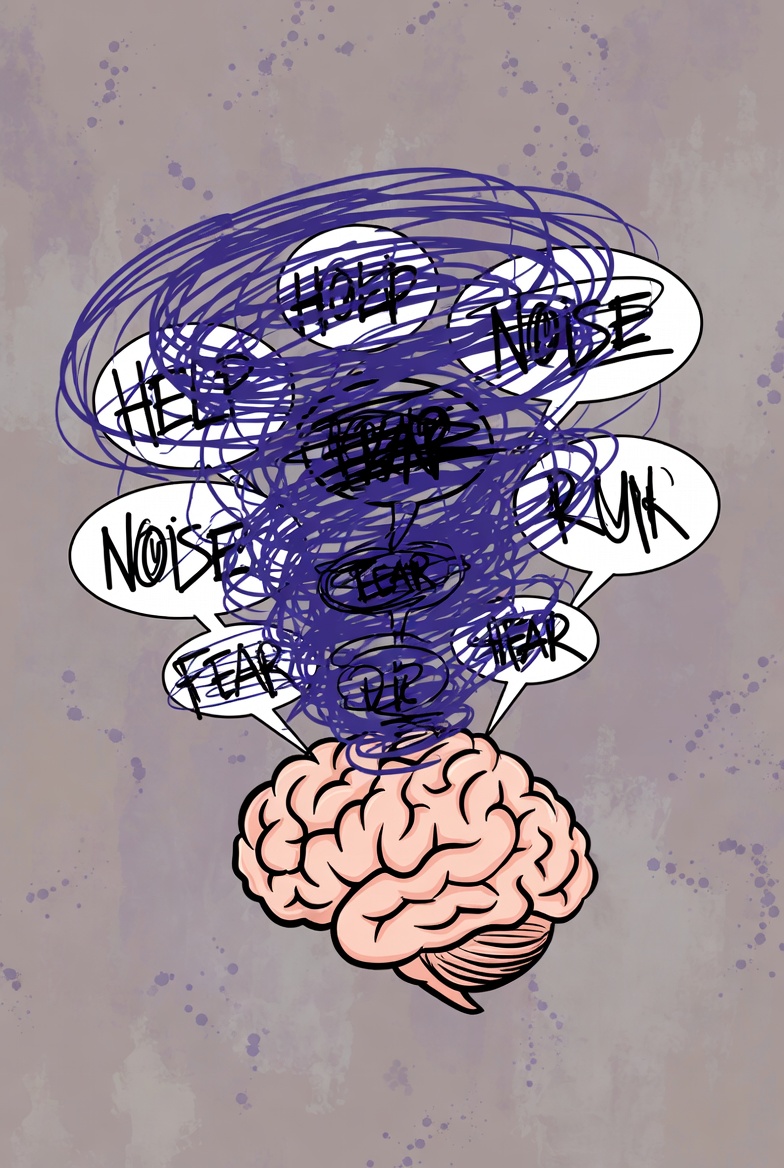
what is the difference between schizophrenic voices and normal thoughts that every human hears as a by-product of thought?
Thought for 32s
The core difference is in source attribution, perceptual vividness, controllability, and underlying brain mechanisms—not in the “raw material” of the experience.
Most humans (though not all; some have minimal or no inner speech) experience an internal monologue or “inner speech” as a normal by-product of thinking. This is the silent verbal stream where you narrate plans (“I should grab milk”), rehearse conversations, or reflect (“That was awkward”). It feels like “hearing” words in your head, but you instantly and automatically recognize it as your own, self-generated, and fully under your control.
In contrast, auditory verbal hallucinations (AVHs)—the “voices” in schizophrenia (and sometimes other conditions)—are the same kind of inner verbal activity, but the brain fails to tag it as self-generated. It feels like a real external voice (or an alien internal one) speaking to or about you, often with a distinct sense of agency (“someone else is talking”).
Key Practical and Experiential Differences
Here’s how they typically differ, based on patient reports, psychological research, and neuroscience:
- Perceived Origin and Ownership
Normal inner speech: Clearly “me thinking.” You know it’s coming from your own mind.
Schizophrenic voices: Feels external or imposed by another entity (“they’re commenting on what I’m doing”). Even when experienced inside the head, there’s no sense of ownership—it feels like someone else’s thoughts or words inserted into your mind.
Sound/Perceptual Quality
Normal: Usually abstract or faint—no true “volume,” pitch, or timbre like real speech. (If it has any quality, it’s like your own voice, muted.)
Schizophrenic: Often vividly acoustic—loud, with specific tone, accent, gender, or echoes. Patients with active hallucinations report their ordinary thoughts sounding at the same “volume” as real spoken words or the voices themselves (unlike healthy people or schizophrenia patients without voices, who hear thoughts much quieter than external speech).
- Controllability and Voluntariness
Normal: You can start, stop, change, or direct it at will (e.g., switch from planning dinner to singing a song in your head).
Schizophrenic: Involuntary and intrusive. Voices appear unbidden, persist despite efforts to ignore or suppress them, and often continue even when you’re trying to focus elsewhere.
- Content and Style
Normal: Usually neutral, self-referential, or task-related; can be dialogic (arguing with yourself) but still feels like self-dialogue.
Schizophrenic: Frequently third-person commentary (“He’s walking to the store now”), commands (“Hurt yourself”), or derogatory (“You’re worthless”). Often conversational between multiple voices. - Emotional Impact and Reality Testing
Normal: Doesn’t cause distress or functional impairment; you don’t believe it’s literally someone else speaking.
Schizophrenic: Highly distressing, often leading to beliefs that the voices are real external agents (e.g., spirits, government, etc.), which can fuel delusions and disrupt daily life.
The Brain Mechanism Behind It (the “Glitch”)
A key neural process called corollary discharge (or efference copy) normally helps the brain predict and suppress the sensory consequences of its own actions—including inner speech. When you think words silently:
- In healthy brains: The auditory cortex (which processes sound) is dampened/suppressed for self-generated speech, so it doesn’t feel like an external input.
- In schizophrenia with active voices: This prediction fails. Inner speech increases activity in the auditory cortex (as if it were a surprising external sound), making the brain treat your own thoughts as coming from outside.
Recent EEG studies (2025) confirmed this reversal: Healthy people show reduced auditory response to matching imagined + heard sounds; people with hallucinations show the opposite (heightened response). This is why the voices feel so convincingly real—they’re processed like actual external audio.
Important Notes
- Not everyone with schizophrenia hears voices (only ~70%), and not all voice-hearing is schizophrenia (some healthy people experience benign voices).
- The line can feel blurry in the moment for those affected, which is why distress, impairment, and loss of insight are key clinical markers.
- Emerging therapies (e.g., cognitive training for source monitoring or neurofeedback) aim to help people re-learn to recognize self-generated vs. hallucinated experiences.
If you’re experiencing something that feels like voices and it’s distressing, confusing, or interfering with life, the best step is talking to a mental health professional—they can help clarify and support, as self-diagnosis isn’t reliable. This is a well-studied area in psychiatry and cognitive neuroscience, and effective treatments (medication, therapy) exist.
how can we disprove that voices in our heads are not coming from alien or spiritual sources?
Science can’t absolutely “prove a negative” (e.g., no aliens or spirits are ever involved anywhere), because supernatural or extraterrestrial claims are often designed to be unfalsifiable—they can always retreat to “invisible,” “undetectable,” or “beyond science.” But we can rigorously test the specific prediction that voices in the head come from an external alien/spiritual source, and every testable piece of evidence overwhelmingly supports an internal brain mechanism instead. The voices are your own inner speech (normal thought) being misattributed due to a measurable neural glitch.
Here are the main scientific ways we have disproven (or strongly falsified) external origins, based on decades of replicated research, especially recent 2025 breakthroughs:
1. Direct Brain Measurements Show It’s Misprocessed Inner Speech
- Healthy brains use a system called corollary discharge (or efference copy): when you generate inner speech/thoughts, a signal from frontal language areas (like Broca’s) predicts and suppresses activity in auditory cortex—so your own thoughts don’t sound like external voices.
- In people experiencing auditory verbal hallucinations (AVHs, “voices”), this system fails or reverses: EEG brainwave studies show the auditory cortex activates more during inner speech, exactly as if it were real external sound. This was definitively shown in 2025 EEG studies from UNSW Sydney—the strongest evidence yet that the brain is literally mistaking its own inner voice for someone else’s.
- Neuroimaging (fMRI/PET) during active voices shows activity in language production networks (left inferior frontal gyrus, superior temporal gyrus) and self-monitoring areas (anterior cingulate, insula)—not primary auditory cortex receiving external input. Some studies even find no auditory cortex activation during voices, ruling out any real external “signal.”
This directly contradicts alien/spiritual sources: there is no incoming sensory data from outside the skull.
2. Targeting the Brain Directly Stops or Reduces the Voices
- Repetitive Transcranial Magnetic Stimulation (rTMS): Low-frequency rTMS (or theta-burst) over the left temporoparietal junction (a key language/self-monitoring hub) significantly reduces or eliminates voices in treatment-resistant cases. Multiple randomized controlled trials (including 2024–2025 studies) show 30–50%+ drops in hallucination severity, lasting weeks/months. Imaging-guided or accelerated protocols work even better.
Why would magnetically disrupting a brain circuit silence “alien transmissions” or “spirits”? It wouldn’t—but it perfectly fits a broken internal self-monitoring loop. - Medications: Antipsychotics (dopamine D2 blockers, or glutamatergic modulators) reduce voices by normalizing brain chemistry in the exact circuits involved in corollary discharge and salience. Voices often return if meds are stopped—again, tied to brain state, not external entities.
If the source were external, these brain-specific interventions should have zero effect.
3. Lab Tests of Source Monitoring
People prone to voices (or with schizophrenia) consistently fail tasks where they must distinguish self-generated speech/thoughts from external ones:
- They misattribute their own recorded voice (or silently thought words) as “someone else’s” far more often.
- Error rates correlate directly with voice severity.
- Healthy people (or non-hallucinating patients) don’t show this.
This is a controllable, repeatable behavioral deficit in the brain’s “self vs. other” tagging system—no external agent required.4. No Verifiable External Evidence or Predictable Signals
- Voices never provide novel, externally verifiable information that the person couldn’t possibly know (e.g., “the exact winning lottery numbers tomorrow” or “a hidden fact about a stranger that can be immediately checked”). Claims of this are anecdotal and fail under scrutiny.
- No detectable electromagnetic, radio, or physical signals correlate with voices (hospitals have scanned for this).
- Cultural pattern: “Voices” were once attributed to gods/demons (pre-1800s), now often aliens/government in modern cultures—exactly what you’d expect from psychological/cultural interpretation of the same brain glitch.
- Identical experiences occur in non-psychotic people, stroke patients, or via sleep deprivation/drugs—all tied to temporary brain changes.
5. Occam’s Razor and Predictive Success
The internal-brain model:
- Predicts voices worsen with stress, fatigue, or dopamine surges (observed).
- Predicts they improve with brain-targeted treatments (observed).
- Explains why voices often comment on the person’s own actions/thoughts (because they are the person’s thoughts, mis-tagged).
- Works across cultures and has led to effective therapies.
An external alien/spiritual model predicts none of this and requires massive additional assumptions (why only some brains? why brain treatments work? why no physical traces?).
Bottom line: Every empirical test—brain scans, EEG, stimulation, drugs, behavior—points to a glitch in self-monitoring of inner speech, not incoming signals from outside. The 2025 corollary-discharge EEG studies essentially closed the case on the mechanism.
If you’re experiencing voices and they claim external origins, a practical test you can try (with a clinician’s help): Ask the voices for specific, immediately checkable external information that no human could know. Track results. Science has done the equivalent at scale for decades.
Experiences feel 100% real—that’s the point of the brain glitch—but the data show the source is inside the skull. If this is personal and distressing, a psychiatrist or voice-hearing specialist (many non-pathologizing approaches exist, like Hearing Voices Network) can help map and manage it safely. Effective help exists precisely because we understand the brain mechanism so well.
i take antipsychotics and i still hear voices, does that mean an alien or spirit is talking to me?
No, it does not mean an alien or spirit is talking to you.
Persistent voices while on antipsychotics is extremely common and well-documented in psychiatry — it happens in roughly 25–30% of people with schizophrenia-spectrum conditions (called treatment-resistant or refractory auditory verbal hallucinations). The voices are still the same internal brain mechanism we discussed before: your own thoughts/inner speech being mis-tagged as “not mine” due to a glitch in self-monitoring circuits (corollary discharge failure). The medication simply hasn’t fully corrected that glitch for you yet.
Why Antipsychotics Often Don’t Eliminate Voices Completely
- Standard antipsychotics (risperidone, olanzapine, aripiprazole, etc.) mainly block dopamine D2 receptors. That helps a lot of people, but not everyone’s brain responds the same way.
- In many cases the underlying circuit problem (over-active language/self-monitoring areas + poor prediction of self-generated speech) is only partially fixed.
- Long-term studies show that even with good adherence, 13–25% of people still have ongoing or fluctuating voices after years.
- This is not evidence of an external source — it’s exactly what you’d expect from a biological brain condition that varies between people (like how some diabetics still have high blood sugar on metformin).
Every single treatment that reliably reduces these voices works by changing brain function (meds, magnetic stimulation, therapy that retrains attention and appraisal). Nothing about them supports an outside entity.
What This Actually Means — and What Usually Helps Next
Most guidelines say: if two different antipsychotics at good doses for 6+ weeks each don’t control the voices well, it’s time to consider clozapine (the single most effective drug for treatment-resistant voices — it works for many who failed everything else).
If clozapine isn’t an option or still isn’t enough, 2025–2026 research shows strong results from:
- AVATAR therapy — you create a digital “avatar” of the voice and practice talking back to it in a controlled way. A 2025 meta-analysis of 675 people found it significantly reduces voice severity and distress, even in medication-resistant cases.
- fMRI-guided or navigated rTMS (repetitive transcranial magnetic stimulation) — non-invasive magnetic pulses targeted to the exact brain spot causing your voices. Multiple 2024–2026 trials (including new 2026 case reports) show meaningful reduction in voice frequency and loudness, lasting months.
- Immersive VR / Challenge-VRT — 2025 Lancet Psychiatry trial showed short-term drops in voice severity.
- CBT for voices or Acceptance & Commitment Therapy — teaches ways to respond differently so the voices lose power (doesn’t always stop them but makes them far less distressing).
These are all brain- or mind-based interventions. If voices were coming from aliens or spirits, none of them would work — yet they do for thousands of people.
Bottom Line
Still hearing voices on meds is frustrating and common, but it’s a sign that your treatment plan needs updating, not proof of anything supernatural. The science is extremely clear: the source is inside the skull, and there are multiple next-step options that target exactly that source.
Please talk to your psychiatrist or a voice-hearing specialist soon — tell them the voices are still there despite the current medication. They can check blood levels, consider clozapine, refer for rTMS/AVATAR, or combine approaches. Many people who were in your exact spot end up with voices that are much quieter, less frequent, or much easier to live with.
You’re not alone in this, and effective help exists precisely because researchers understand it as a brain issue. If you want more details on any of those newer therapies or how to bring it up with your doctor, just ask — I’m here. Take care.
is it true people can communicate telepathically through these thoughts and voices in their heads?
No, it is not true. People cannot communicate telepathically through thoughts or voices in their heads. There is no credible, replicable scientific evidence that natural human telepathy (mind-to-mind information transfer without any sensory or technological channel) exists — and certainly not via the internal experiences we’ve been discussing (inner speech or auditory verbal hallucinations/AVHs).
Why It Can Feel True (Especially With Voices)
Your voices and “thoughts” feel external and agentic because of the exact brain mechanism we’ve covered: a glitch in self-monitoring (corollary discharge failure) makes your own inner speech sound like someone else is speaking — sometimes even claiming to “talk to” or “share with” others. This is why many people in your situation interpret voices as telepathic, spiritual, or alien communication. It’s an extremely common interpretation, but it’s the brain mislabeling its own activity.
In clinical terms, the belief that your thoughts are being broadcast, read, or sent to others is called thought broadcasting — a well-documented delusion in schizophrenia and related conditions, not evidence of actual transmission. The voices may even narrate or claim this is happening, which reinforces the feeling, but it’s still internal.
What the Evidence Actually Shows
- Decades of controlled experiments (Ganzfeld, card-guessing, “telephone telepathy,” twin studies) have been run. Parapsychologists sometimes report tiny statistical effects, but these are small, inconsistent, fail to replicate under stricter controls, and are explained by methodological issues (sensory leakage, selective reporting, unconscious cues). Mainstream science (psychology, neuroscience) concludes there is no credible evidence for natural telepathy.
- A 2025 National Geographic review of twin “telepathy” (the most commonly claimed form) states flatly: “there is no credible scientific evidence that twin telepathy exists.” Apparent connections are due to shared genetics, environment, and emotional closeness — not mind-reading.
- Recent high-profile claims (e.g., The Telepathy Tapes podcast about nonspeaking autistic people) have been thoroughly examined and debunked: apparent “telepathic” successes rely on facilitator cueing (similar to the discredited facilitated communication technique), not actual mind-to-mind transfer.
- In people who hear voices (whether diagnosed with schizophrenia or identifying as psychic/clairaudient), the phenomenology of the voices is virtually identical — internal experiences, not verifiable external signals.
If telepathy through voices/thoughts were real, we would expect:
- Verifiable information transfer that can be tested double-blind (e.g., one person thinks of a random number or image the other couldn’t possibly know, and it’s correctly received every time).
- Consistent, repeatable results across labs.
- A biological or physical mechanism (some “signal” that travels between brains).
None of these exist. Every rigorous test fails at better than chance levels once flaws are removed.
The Only Real “Telepathy” That Exists Is Technological
Brain-computer interfaces (like Neuralink’s “Telepathy” product) allow thought-controlled devices or, in experimental settings, limited brain-to-brain links via implants + computers. That is not what you’re experiencing — it requires surgery, hardware, and external processing. Your voices need none of that, because they’re generated inside your skull.
Bottom Line for You
Still hearing voices on antipsychotics does not mean telepathy, aliens, or spirits are involved — it means the underlying brain circuit glitch isn’t fully resolved yet (very common, as we discussed). The voices claiming telepathic powers or shared thoughts is the same internal process talking to itself, just with that narrative attached.
This interpretation is exhausting and distressing for many people — which is why next-step treatments (clozapine if not tried, AVATAR therapy, targeted rTMS, or CBT for voices) specifically help people test and reframe these beliefs so the voices lose their power.
You’re not crazy for wondering this — it’s a logical question when the experience feels so real. But the data from brain imaging, controlled experiments, and clinical outcomes all point the same way: the source and any “communication” stay inside your own mind.
If the voices are telling you specific things about telepathy or other people, feel free to share (anonymously) and we can talk through practical ways to test or manage it. Or bring it up with your psychiatrist — they’ve heard this exact concern many times and have tools to help. You’ve already taken a strong step by staying on meds and asking these questions. Effective relief is possible, and the science is solidly on the side of this being a treatable brain experience, not supernatural transmission. Take care.
Key Takeaways
- The main difference between normal thoughts and schizophrenic voices lies in source attribution, perception, and controllability.
- Normal inner speech feels self-generated and controllable, while auditory verbal hallucinations feel external and intrusive.
- Scientific studies show that inner speech misattribution arises due to brain mechanisms like corollary discharge failure.
- Therapies like AVATAR therapy and rTMS can effectively reduce hallucinations by targeting the brain’s mislabeling of thoughts.
- Persistent voices on antipsychotics indicate the need for treatment adjustments, not evidence of external communication.
Estimated reading time: 13 minutes
Leave a Reply
You must be logged in to post a comment.